Forum for Graduate Students, Faculty Researchers: Using AI in Breast Cancer Diagnosis
Seeking presenters
Learn@Research Lib Forum is now seeking presenters for Spring 2026. Reply to LearnResearchForum@utk.edu.
Engineering professors Xueping Li and Bing Yao will speak about using artificial intelligence (AI) to expedite treatment plans for breast cancer patients. Their presentation, noon to 1pm, November 19, via Zoom, is part of a forum for graduate and faculty researchers. Register here.
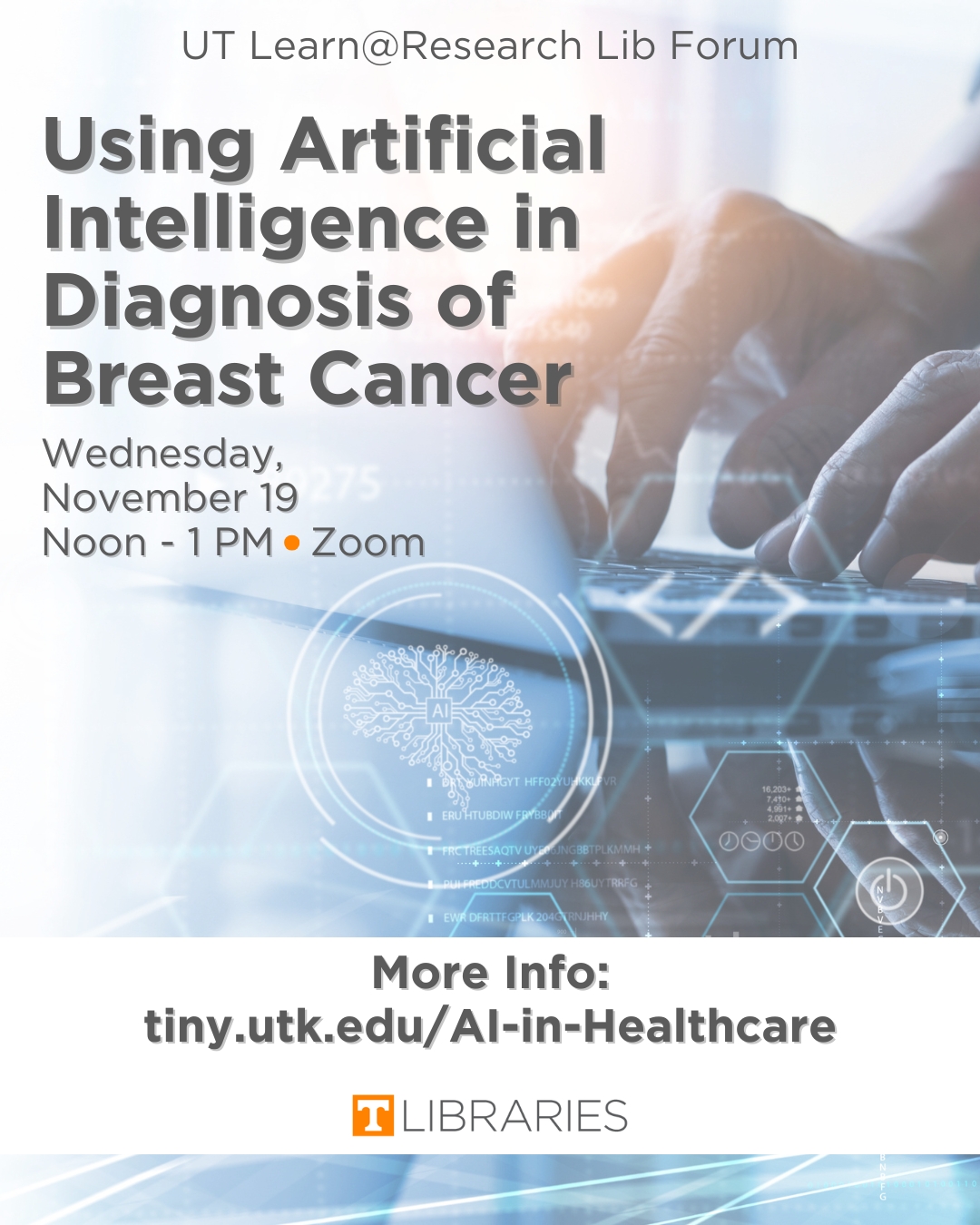
The presentation is part of the UT Learn@Research LibForum, a collaboration between UT Libraries and the Graduate School’s Office of Postdoctoral Affairs. Presented by and for researchers, the mission of the forum is to cultivate a strong research community across the University of Tennessee via presentations and colleague interactions. The forum is now seeking presenters for Spring 2026. Interested PhD candidates, postdoctoral researchers, and faculty should contact the forum sponsors at LearnResearchForum@utk.edu to volunteer or for more information.
Li and Yao recently collaborated with the UT College of Nursing and UT Medical Center to develop a program that could revolutionize breast cancer diagnosis. In this session, they will talk about how AI is being applied to speed up analysis of pathology reports and determine treatment plans for breast cancer patients.
Describing the size, location, and extent of a cancer — a process called staging — helps doctors determine the best course of treatment. Staging requires scouring and extracting data from pathology reports and other clinical records, a process that is both time-consuming and error-prone.
Using almost 300,000 anonymized pathology reports from across Tennessee, UT researchers developed a process that uses pretrained deep learning models to extract data and apply cancer staging rules.
“If you were to diagnose cancer stages manually from these 300,000 pages — if you did it by hand, and you didn’t eat and didn’t sleep — it would take about 14 years,” Li said. “With these algorithms, we were able to do it in under one hour.”
The tool is not intended to replace humans, the researchers stress, but to help ensure that the staging results manually reached by healthcare professionals are correct.